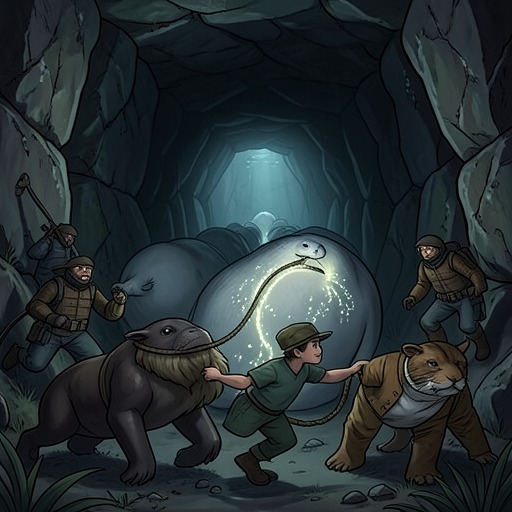
Kerick Booterin
The Jungle BookKerick Booterin is the chief seal-hunter on Novastoshnah, the North East Point of Saint Paul Island in the Bering Sea. He supervises the human work that converts the seals’ summer return into a supply of skins, and his brief encounter with the white seal Kotick gives the slaughter a recognizable human agent. Kerick is not presented as a solitary villain but as the commanding functionary of a practiced system: he knows the terrain, controls the herd, judges the pace of the drive, and orders the killing with the calm efficiency of long experience.
Identity and Setting
Kerick lives in the small village near Novastoshnah’s seal nurseries and works with his son, Patalamon. The island is described as a place visited almost exclusively for business, while the seals arrive in summer by hundreds and hundreds of thousands because Novastoshnah Beach offers exceptionally good accommodation. Kerick’s livelihood is therefore built around a recurring natural migration. The seals’ return is at once a biological event and a commercial opportunity, and he occupies the human position that organizes that opportunity.
His authority is explicitly professional. He is identified as the chief of the seal-hunters on the island, and the men under him drive seals as if they were sheep toward killing pens, where their skins will later become seal-skin jackets. The comparison strips away any romantic distance from the process: the animals are herded, sorted, and processed through a routine that resembles livestock management, even though the setting is a wild beach and the victims are migratory marine animals.
The White Seal Encounter
Kerick first encounters Kotick during a summer night of play among the yearling seals. Kotick’s white coat makes him immediately conspicuous, and Patalamon calls attention to him. Kerick reacts with alarm rather than simple curiosity. He turns nearly white beneath the oil and smoke on his face, mutters a prayer, and warns Patalamon not to touch the animal because no white seal has appeared within his memory. He connects Kotick with the ghost of Zaharrof, a seal hunter lost in the previous year’s gale.
This reaction gives Kerick a second register beyond his occupational hardness. He is capable of superstition, and the white seal briefly unsettles the authority that he otherwise exercises over the herd. Yet the superstition does not lead him to question the killing itself. After warning Patalamon away from Kotick, Kerick immediately returns to the practical business of selecting and driving seals. The extraordinary animal is treated as an omen, while the ordinary violence surrounding him remains unquestioned.
Kotick follows the herd, becoming the first seal to come alone to the killing grounds. Kerick notices the pursuit and again interprets the white seal as Zaharrof’s ghost, saying that he must speak to the priest. His fear is therefore directed toward an uncanny sign, not toward the moral meaning of the slaughter. The scene places human superstition and institutional violence side by side: Kerick is frightened by what he cannot explain, but perfectly composed before what he has done for thirty years.
Control of the Seal Drive
Kerick manages the drive with detailed knowledge of the animals’ physical limits. The killing grounds lie only half a mile from the beach, but he takes an hour to cover the distance because overheated seals lose their fur in patches when skinned. He leads the herd slowly past Sea Lion’s Neck and Webster House to the Salt House, then allows it to cool for thirty minutes while he consults a heavy pewter watch. The delay is not mercy; it is part of preserving the commercial value of the bodies.
When the men arrive with iron-bound clubs three or four feet long, Kerick identifies which animals should be removed from the main group. Seals bitten by their companions or made too hot are kicked aside in their heavy walrus-throat-skin boots. Kerick then gives the order to release the herd, and the men club the seals on the head as quickly as possible. His command reduces a large, confused movement of animals to a sequence of controlled operations: drive, cool, sort, release, kill.
The scale of the work is also governed by his judgment. At the beginning of the season, he tells Patalamon that the men ought to skin two hundred seals but that a hundred will be sufficient because the animals are new to the work. The decision presents slaughter as a quota and a labor calculation. Kerick’s expertise lies not only in directing violence but in regulating its pace and volume according to the condition of the herd and the efficiency of the workers.
The narrative emphasizes that this is established practice rather than an exceptional outburst. A sea lion tells Kotick that old Kerick has been polishing off a drove for thirty years. Kerick is consequently the human face of a longstanding seasonal mechanism. His personal habits and superstitions make him visible, but the repetition of his work makes clear that the system would not depend on his personality alone.
Conflict with Kotick’s Witness
Kotick’s presence changes the meaning of Kerick’s routine because Kotick follows the herd and sees what the other seals have not seen. The seals on the beach continue playing while hundreds of their companions are driven away, and none of Kotick’s companions can explain the process beyond noting that men do it every year for six weeks or two months. Kerick’s work is therefore protected by distance and repetition. The community accepts what it has not witnessed directly.
Kotick crosses that boundary. At the killing grounds he watches familiar seals lose their skins, ripped from nose to hind flippers and thrown into a pile. The sight horrifies him, and he races back to the sea. Kerick’s efficiency thus produces an unintended witness: the white seal who cannot return to ordinary play because he has learned what the seasonal practice means from inside its route.
When Kotick returns to Novastoshnah, the other seals do not sympathize. They say that men have always driven the holluschickie and that anyone unwilling to see ugly things should not have gone to the killing grounds. Their response shows how Kerick’s routine has become normalized by those who remain outside it. Kotick’s difference is intensified by his white coat, but his moral isolation comes primarily from having seen the process that everyone else treats as part of the day’s work.
Narrative Function and Significance
Kerick is a compact but consequential figure in the account of Kotick’s search for safety. Through him, the story moves from the beauty and abundance of the seal beach to the industrial logic of the killing grounds. His watch, his sorting judgment, his command, and the clubs of his men make the violence procedural rather than chaotic. The horror comes not from a single uncontrolled act but from the smoothness with which the work is performed.
His encounter with Kotick also establishes a contrast between human interpretation and animal knowledge. Kerick can imagine a ghost returning from a gale, yet he does not imagine the seals as beings whose continued presence might challenge the practice. Kotick, by contrast, begins with questions and ends with a project: he leaves the beach to search the Pacific for Sea Cow and for an island with firm beaches where men cannot reach the seals. Kerick does not pursue or debate that project, but his work supplies its cause.
Kerick therefore represents the durable human order against which Kotick’s quest is formed. He is observant, disciplined, and technically competent, but those qualities serve an exploitative routine. The story does not need to make him theatrically cruel; his ordinary competence is more disturbing. By showing him as a manager of timing, numbers, bodily condition, and labor, the narrative makes clear how violence can become invisible to those who perform it—and how a single witness can make that invisibility impossible for everyone who hears the tale.